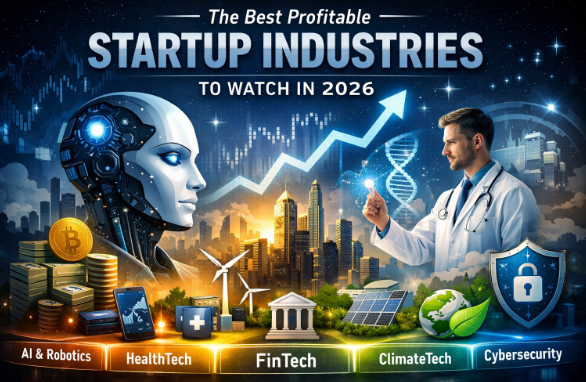
The global startup ecosystem continues evolving at an extraordinary pace, and 2026 is shaping up to be one of the most dynamic years for new business opportunities. Entrepreneurs, venture capitalists, and digital innovators are closely watching emerging markets where technology, consumer demand, and global investment converge. If you are exploring profitable startup industries in 2026, understanding where innovation meets scalability is essential.
Startup success rarely happens by accident. It occurs when founders identify industries experiencing massive structural change. Whether driven by artificial intelligence, healthcare innovation, sustainability demands, or digital infrastructure, the next wave of profitable startups will emerge from sectors capable of scaling quickly while solving real-world problems.
In this comprehensive guide, we explore the best profitable startup industries to watch in 2026, including high-growth markets, emerging technologies, and investment opportunities that could define the next decade of entrepreneurship.
Why 2026 Is a Breakthrough Year for Startup Opportunities
The startup environment entering 2026 is unlike any previous decade. Advances in computing power, the rise of artificial intelligence platforms, and global digital connectivity are reshaping the way businesses are built. What once required millions of dollars in funding can now be launched with a lean team and scalable cloud infrastructure.
Several factors are driving this transformation.
First, AI-powered automation is dramatically reducing operational costs, enabling startups to build sophisticated products with minimal human resources. Second, global access to venture capital has expanded through decentralized finance, crowdfunding platforms, and international accelerator programs. Third, consumer demand for innovative digital solutions continues to grow rapidly across industries.
These shifts mean entrepreneurs now have access to tools that were previously only available to large corporations. Cloud platforms, machine learning models, and global payment systems allow startups to reach international markets almost instantly.
Another key factor is the rise of industry convergence, where sectors like healthcare, fintech, and artificial intelligence merge to create entirely new business categories. Startups that combine technologies—such as AI healthcare diagnostics or blockchain-based financial systems—are attracting significant investor attention.
For founders looking to launch a company, understanding which sectors offer the strongest growth potential is the first step toward building a profitable startup.
Artificial Intelligence Startups Leading the Innovation Economy
Artificial intelligence remains the most influential technology shaping the startup landscape. In 2026, AI startups are expected to dominate venture capital funding and global innovation pipelines.
AI is no longer limited to research laboratories or technology giants. Today, startups are deploying artificial intelligence across industries including healthcare, finance, marketing, education, and logistics.
The most promising AI startup models involve vertical AI solutions, which focus on solving highly specific industry problems rather than building generic AI platforms.
Examples include:
| AI Startup Sector | Business Opportunity | Revenue Potential |
|---|---|---|
| AI Healthcare Diagnostics | Automated medical imaging analysis | Very High |
| AI Customer Service Automation | Intelligent chatbots and support agents | High |
| AI Content Creation | Automated marketing content tools | High |
| AI Predictive Analytics | Data-driven forecasting platforms | Very High |
One reason AI startups are so profitable is scalability. Once an AI model is developed and trained, it can be deployed globally with minimal additional cost.
Another advantage lies in data-driven value creation. Companies that collect and analyze large data sets can continuously improve their algorithms, creating powerful competitive advantages.
For entrepreneurs, launching an AI startup in 2026 means entering a market where innovation and profitability often go hand in hand.
HealthTech Startups Transforming the Global Healthcare Industry
Healthcare innovation has accelerated dramatically over the past decade, and HealthTech startups are expected to become one of the most profitable startup sectors by 2026.
The global healthcare industry faces several major challenges: aging populations, rising medical costs, and limited access to healthcare services in many regions. Startups are addressing these problems with digital technologies that improve efficiency, accessibility, and patient outcomes.
HealthTech startups typically focus on areas such as:
- Telemedicine platforms
- AI-powered diagnostics
- Personalized medicine
- Remote patient monitoring
- Digital therapeutics
Telemedicine alone has become a multibillion-dollar industry, enabling patients to consult with healthcare professionals through secure video platforms and mobile applications.
AI-powered diagnostic systems are also gaining traction. These systems analyze medical imaging, patient histories, and genetic data to help doctors detect diseases earlier and with greater accuracy.
Another promising opportunity lies in wearable health technology, which allows individuals to track their vital signs and health metrics in real time. Data collected from these devices can be analyzed using AI algorithms to predict potential health risks before symptoms appear.
For entrepreneurs interested in launching a startup that combines profitability with social impact, the HealthTech industry offers tremendous potential.
FinTech Innovation and the Future of Digital Finance
The financial services industry is undergoing a digital transformation, creating massive opportunities for FinTech startups focused on modernizing financial infrastructure.
Consumers increasingly expect seamless digital experiences when managing their finances. Traditional banking systems often struggle to meet these expectations due to outdated technology and regulatory constraints.
FinTech startups are stepping in to fill this gap.
Some of the most promising FinTech startup models include:
| FinTech Segment | Key Innovation | Growth Potential |
|---|---|---|
| Digital Banking | Mobile-first banking platforms | Very High |
| Payment Processing | Cross-border payment solutions | High |
| Blockchain Finance | Decentralized financial systems | High |
| WealthTech | AI-driven investment platforms | Very High |
Digital banks, often referred to as neobanks, offer simplified financial services through mobile applications. These platforms eliminate physical branches and operate with lower costs, allowing them to provide competitive financial products.
Blockchain-based finance is another emerging sector attracting investment. By enabling secure and transparent financial transactions without intermediaries, blockchain technology has the potential to reshape global financial systems.
Entrepreneurs launching FinTech startups must navigate regulatory environments carefully, but the potential rewards are enormous.
Climate Technology and the Rise of Green Startups
Sustainability has become a global priority, and governments, corporations, and investors are increasingly supporting climate-focused startups.
ClimateTech startups develop technologies that reduce environmental impact while creating profitable business models.
Key ClimateTech startup categories include:
- Renewable energy solutions
- Carbon capture technology
- Sustainable agriculture platforms
- Electric mobility infrastructure
- Green building technologies
Renewable energy startups are particularly attractive to investors because global demand for clean energy continues to rise. Solar energy, wind power, and energy storage solutions are all experiencing significant growth.
Another emerging opportunity lies in carbon management platforms, which help companies measure, reduce, and offset their carbon emissions. With increasing regulatory pressure to achieve carbon neutrality, businesses are actively seeking solutions in this area.
ClimateTech startups are not only profitable but also aligned with global sustainability goals, making them appealing to impact investors.
Cybersecurity Startups Protecting the Digital Economy
As businesses become increasingly digital, cybersecurity threats are growing more sophisticated and more frequent. This trend has created a massive market for cybersecurity startups.
Organizations of all sizes must protect sensitive data, financial systems, and customer information from cyberattacks. Startups developing innovative security solutions are therefore in high demand.
Cybersecurity startups typically focus on:
- Cloud security platforms
- Identity and access management
- AI-powered threat detection
- Data privacy protection tools
- Zero-trust security architectures
One particularly promising trend is AI-driven cybersecurity, where machine learning algorithms detect suspicious behavior and automatically respond to potential threats.
Startups operating in the cybersecurity sector often enjoy strong recurring revenue models because businesses require continuous protection.
For entrepreneurs interested in building a startup with long-term demand, cybersecurity remains one of the most resilient industries.
EdTech Startups Reshaping the Future of Learning
Education technology has experienced explosive growth, especially with the expansion of online learning platforms. By 2026, EdTech startups are expected to play a major role in transforming how people acquire skills and knowledge.
Traditional education systems often struggle to keep pace with rapidly changing job markets. EdTech startups address this gap by offering flexible, technology-driven learning solutions.
Examples include:
- AI-powered personalized learning platforms
- Online certification programs
- Virtual classrooms and collaboration tools
- Corporate training platforms
One powerful trend is microlearning, where educational content is delivered in short, focused lessons optimized for mobile devices.
Another opportunity lies in skills-based education platforms, which teach practical abilities required in industries such as software development, digital marketing, and data analytics.
As companies prioritize workforce development and continuous learning, EdTech startups are becoming increasingly valuable.
Digital Media and Creator Economy Startups
The creator economy has grown rapidly as individuals build audiences on social platforms and monetize their content through advertising, subscriptions, and digital products.
Startups serving the creator economy develop tools that help content creators produce, distribute, and monetize digital media.
Popular startup categories include:
- Creator monetization platforms
- AI video production tools
- Social media analytics platforms
- Influencer marketing marketplaces
These businesses benefit from powerful network effects. As more creators join a platform, the value of the ecosystem increases for advertisers, brands, and audiences.
For entrepreneurs interested in digital media, the creator economy offers enormous potential.
Key Traits of Highly Profitable Startup Industries
While industries differ, successful startup sectors often share several common characteristics.
First, they address large global markets with strong demand. Second, they rely on technologies that enable rapid scalability. Third, they solve meaningful problems that customers are willing to pay to resolve.
Successful startup industries also benefit from recurring revenue models, such as subscription services or software platforms.
Startups that combine these characteristics are far more likely to achieve sustainable growth.
Conclusion
The startup ecosystem entering 2026 is defined by technological breakthroughs, global connectivity, and rapidly evolving consumer needs. Entrepreneurs who understand where innovation meets market demand can build businesses that scale quickly and generate significant returns.
Among the most promising opportunities are AI startups, HealthTech innovation, FinTech platforms, ClimateTech solutions, cybersecurity services, EdTech platforms, and creator economy tools. Each of these sectors addresses critical challenges while leveraging advanced technologies capable of transforming entire industries.
For aspiring founders and investors alike, the key lies in identifying industries with strong growth trajectories and building solutions that create real value for customers.
The next generation of successful startups will not simply follow trends—they will define them.
FAQs
1. Which startup industry will grow the fastest in 2026?
Artificial intelligence startups are expected to experience the fastest growth due to increasing adoption across industries such as healthcare, finance, marketing, and cybersecurity the best profitable startup industries.
2. What makes a startup industry profitable?
A profitable startup industry typically has strong market demand, scalable technology, recurring revenue potential, and opportunities for global expansion.
3. Is healthcare a good startup industry in 2026?
Yes. HealthTech startups focusing on telemedicine the best profitable startup industries, AI diagnostics, and wearable health devices are attracting significant investment and showing strong growth potential.
4. Are climate startups profitable?
ClimateTech startups are becoming increasingly profitable as governments and corporations invest heavily in sustainable technologies and renewable energy solutions.
5. What skills are important for startup founders in 2026?
Key skills include technological understanding the best profitable startup industries, data analysis, digital marketing, product development, and the ability to adapt quickly to changing market conditions.
Read More :